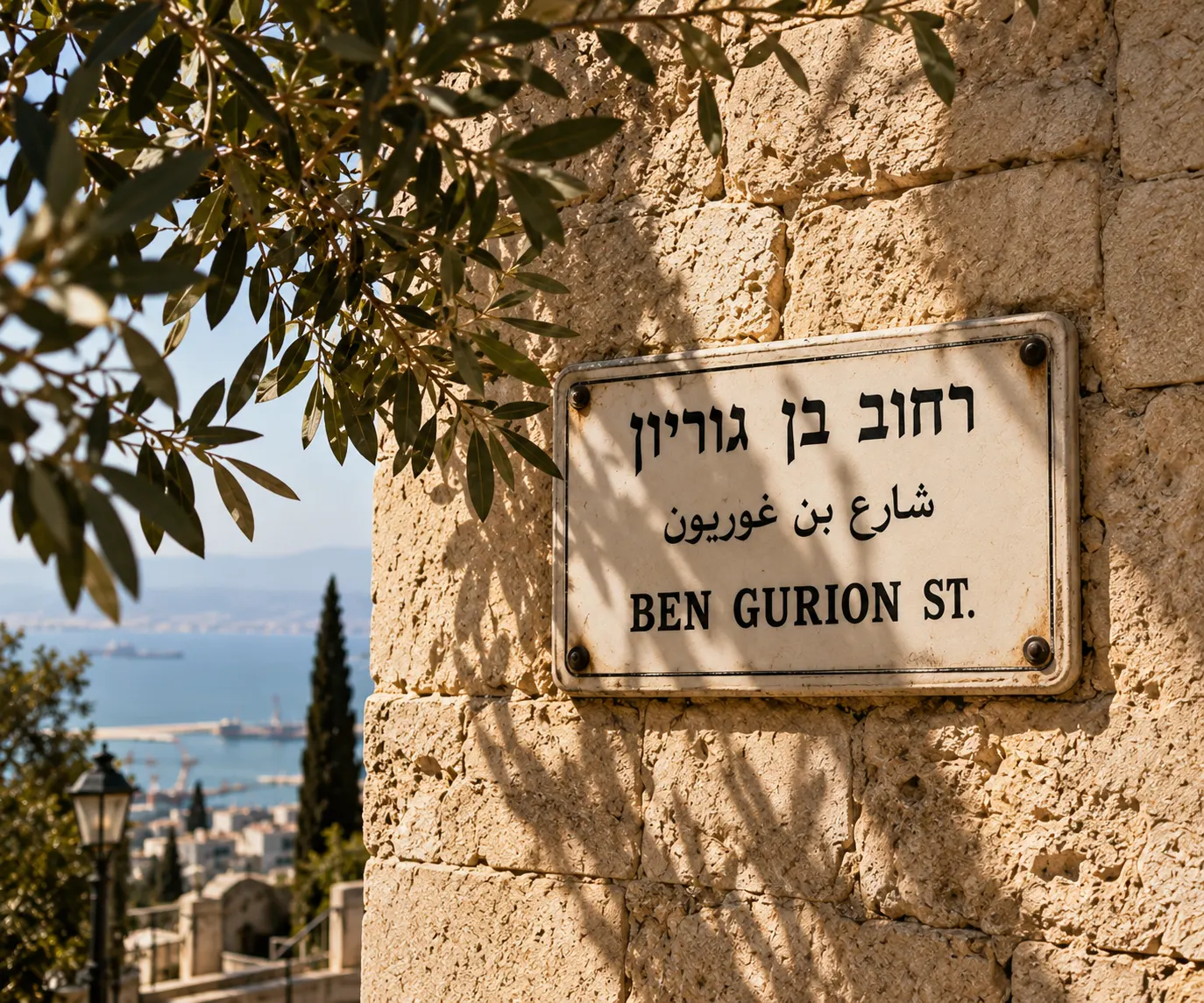
Phenomenology & Environment · Course project
Living in the Shadow
Four readings of an invisible street · Ben Gurion Street, Haifa
What does it mean to live in the shadow of a place — of its light, its history, and the people who made it?
Phenomenology & Environment · Course project
Four readings of an invisible street · Ben Gurion Street, Haifa
What does it mean to live in the shadow of a place — of its light, its history, and the people who made it?
Abstract
A shadow is more than the absence of light.
This work offers four phenomenological readings of Ben Gurion Street in Haifa around a single concept: shadow. “Shadow” is chosen here as a concept rather than as the description of one phenomenon alone: sometimes it is the literal shadow cast by light, and sometimes it is used in an extended sense — a presence that lies outside the field of vision and keeps acting on experience. What the senses share is how they operate: something we do not look at, which nevertheless organises what we see, how we walk, and how we find our bearings in the place.
Over the course of the work it became clear that the shadow operates on this street in four senses, distinct in what casts them and alike in how they act. The four senses are also the order of the four readings below:
The argument of the work is that these are not four separate metaphors but one phenomenon in four keys: in each of them something unseen organises the experience of the place. Ben Gurion Street, given as the subject of the work within the course, is particularly suited to this examination: it was built and inhabited in layers — periods, languages and ways of life accumulated one upon another — and the four senses overlap there within a single walking distance: light that builds space, a sea and a mountain beyond the roofline, time that stays in the stone, and people who are gone and still direct the step.
The structure is uniform: each reading opens with a question and a short text, sets out the work done in response, and closes with the concepts, thinkers and sources behind it.
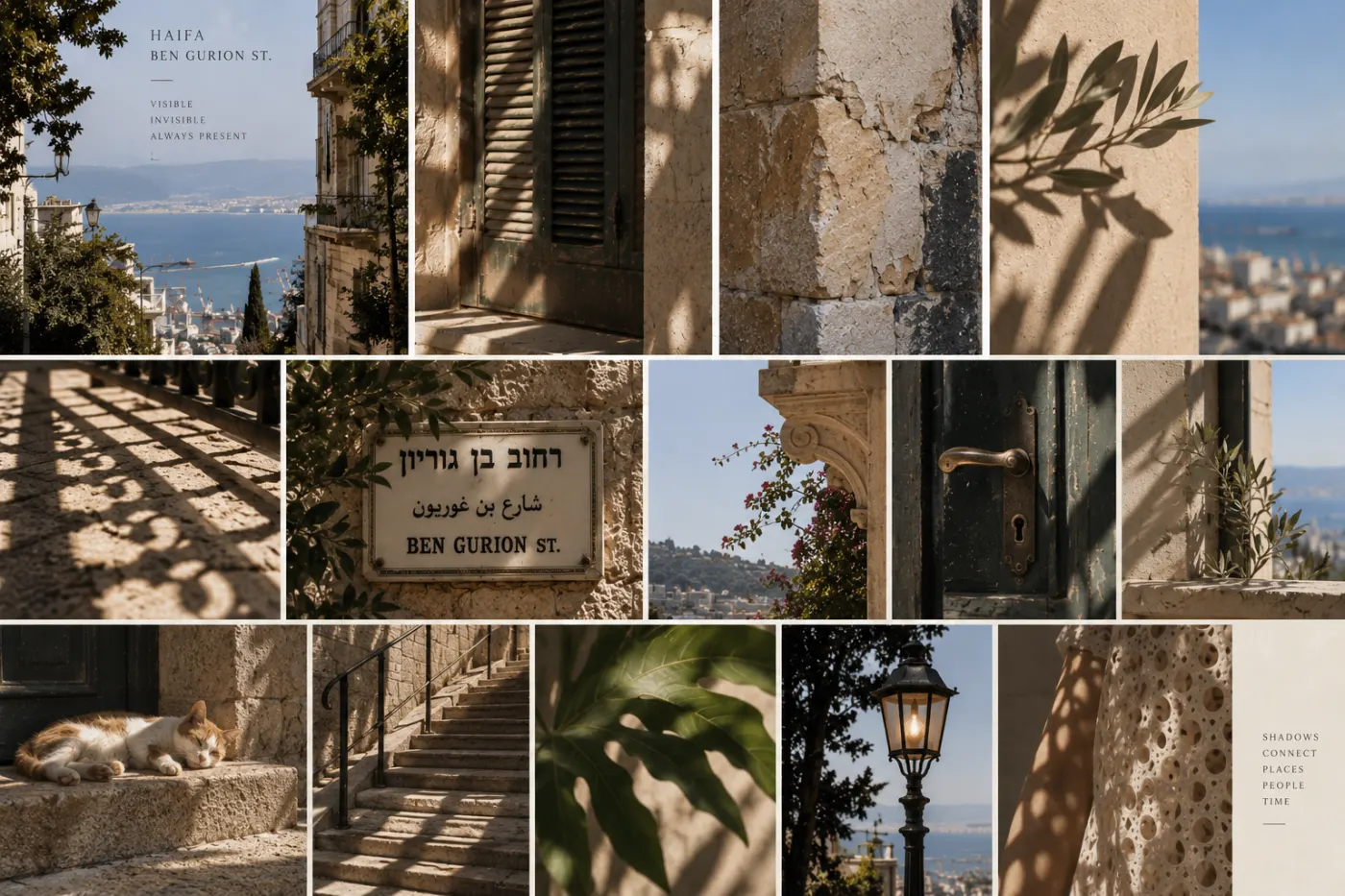
A note on the material. The images on this page are conceptual visualisations made while editing the document; they are not field documentation. The field photography from Ben Gurion Street — together with the light-and-shadow model and the fabric experiments — is in progress and will replace the visualisations before submission. The production list at the end of the document sets out what is required for each reading.
The readings
The physical shadow · Reading I · Light · Shadow · Time
Light, shadow and time on the street — and how a physical phenomenon becomes a condition of perception.
How does light build and dismantle space over the course of a day?
The work begins where the shadow begins: in light. On Ben Gurion Street light does not merely illuminate the architecture — through the day it builds it and takes it apart. A recessed doorway becomes a shaded room in the morning and a flat surface at noon; a colonnade that shelters at one hour exposes at another. Shadow draws walls, thresholds and temporary boundaries that the stone itself does not define: a room appears although no walls were ever built for it. That space also dictates behaviour — where we stop, where we sit, which side of the street we walk on and at which hours — and most of us comply without noticing. Le Corbusier’s statement that our eyes are made to see forms in light is read here not as a remark about beauty but about construction.
For Tadao Ando, Louis Kahn and Steven Holl, light counts as the primary material of space rather than a service added to it; in the spirit of the principle attributed to Kahn, one does not subtract darkness but adds light. On this reading, shadow is not a fault but the ground against which architecture becomes legible. Such a reading of the street asks for attention rather than a glance: the same corner is watched over hours, because its character is not a fixed property but an event in time.
And, more importantly, the shadows cast by light are not formless. The dappled light beneath the street’s trees, the barred rhythm of shutters and screens, the soft penumbra at the edge of the stone — together these make up a visual language with a grammar of its own: rhythm, density and edge. This grammar is not ornament but a condition of perception: it decides where the eye stops, where walking slows, and where a boundary is read that the stone does not define. The reading stays here within the limits of the phenomenon. Still, a pattern read across a material is already a form — and a form can be carried further; that step is discussed separately, in “From Shadow to Second Skin”.
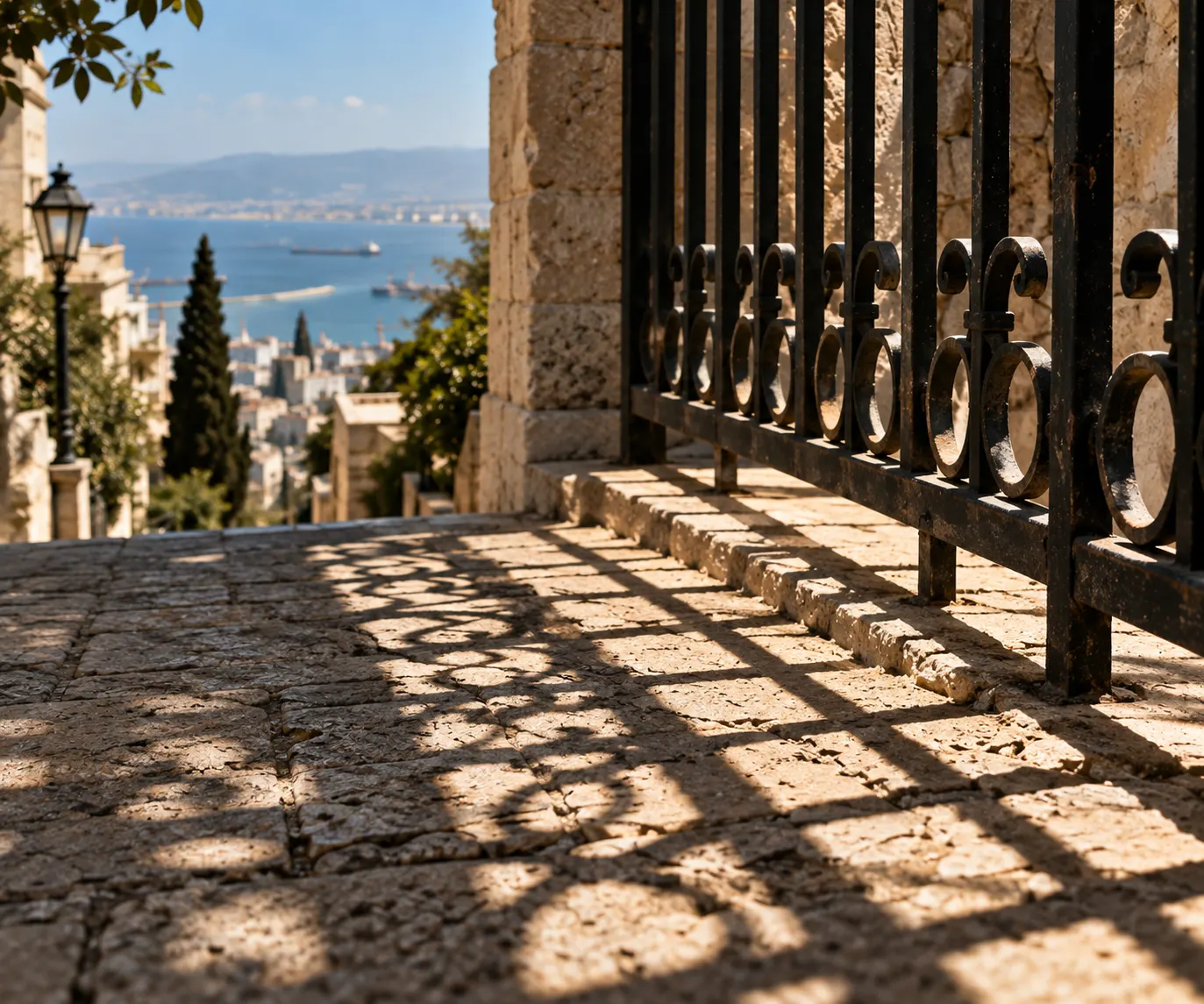
“I started photographing shadows because they were beautiful. Later I noticed that I was documenting time — the same wall is never the same wall twice.”
The shadow of place · Reading II · Sea · Mountain · Atmosphere
The sea, the Carmel and the gardens are barely visible — and their presence is felt at every step.
How can a landscape stay present without being seen?
A place, too, can cast a shadow. The Mediterranean lies behind the walker; Mount Carmel and the Baha’i Gardens rise above and behind the façades. Along most of the street none of them is the object of the gaze, and yet all of them are distinctly present — carried in the wind, in the weight of humid air, in the constant pull of the slope that turns every step toward the water. This is a street living in the shadow of its own landscape.
Merleau-Ponty offers the precise image in Eye and Mind. Looking at the tiled floor of a pool, he insists that he does not see it despite the water but through it: the water inhabits the space and is realised in it, without ever being contained as an object. This is exactly how the sea acts upon the street — neither in front of me nor absent, but dwelling in the air and the light. To perceive a place phenomenologically is to treat these invisible presences as constitutive rather than incidental.
The reading therefore rests on the lived body — the corps propre — more than on the measuring eye. The body registers the pull of the sea through gravity and slope before the eyes confirm a horizon; it reads direction, humidity and temperature as a single field. This is also what Norberg-Schulz calls genius loci: an atmosphere derived from the place as a whole rather than from its visible parts.
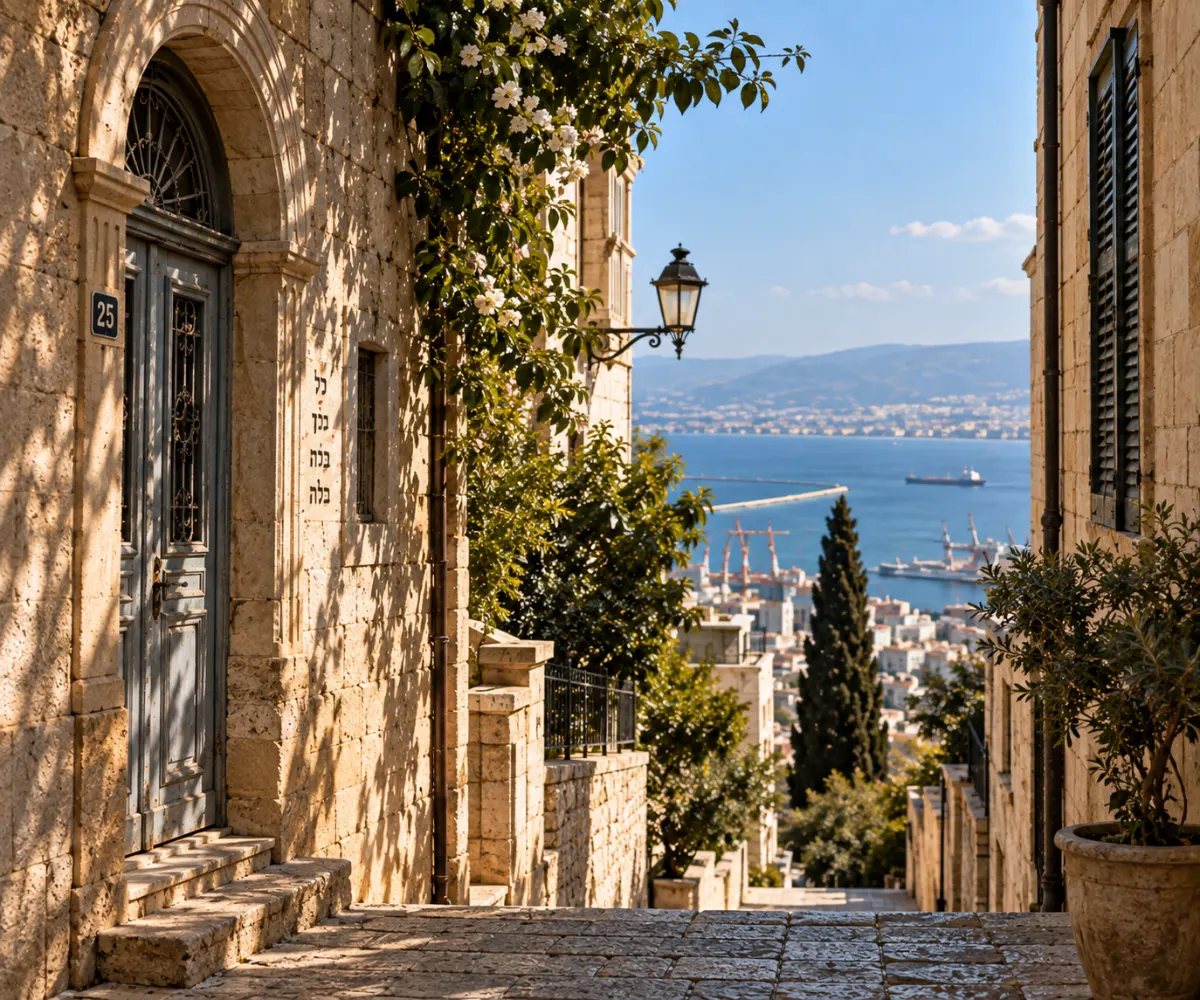
“I kept turning to look for the sea and could not find it — and realised that my body already knew it was there. The whole street leans toward water you can barely see.”
The shadow of history · Reading III · Material · Layer · Memory
Periods do not merely pass — they stay, embedded in stone, in detail, in the identity of the street.
How can material carry memory?
History casts a long shadow, and the street lives inside it. But the past of Ben Gurion Street is not met here as a narrative — it is met as material. Aldo Rossi’s proposition that the history of architecture is the material of architecture directs the approach. Successive periods are legible in the courses of stone, in proportions and detail, in the patina of plaster and the wear of thresholds — and these layers sit physically side by side, one surface holding several times at once.
The course offers a precise image for this in “the discipline of the existing” — a ghostly presence across the changing life of a building, the physical quality of time embodied in things. Memory here is not psychological but material; it is touched before it is interpreted. To read it, the project works as an archaeology of place: not a chronological record of the street’s history, but an exposure of its foundations — the “genome” from which its character was formed. The reading thus stays phenomenological rather than historical, concerned with how the past is experienced on the surface of the present.
In Bachelard’s The Poetics of Space the deeper claim appears: memory needs matter in order to dwell — duration shelters in things and places, not in consciousness alone. The material of the street becomes an archive read by the body: a layered text in which the oldest lines are still visible beneath the newest.
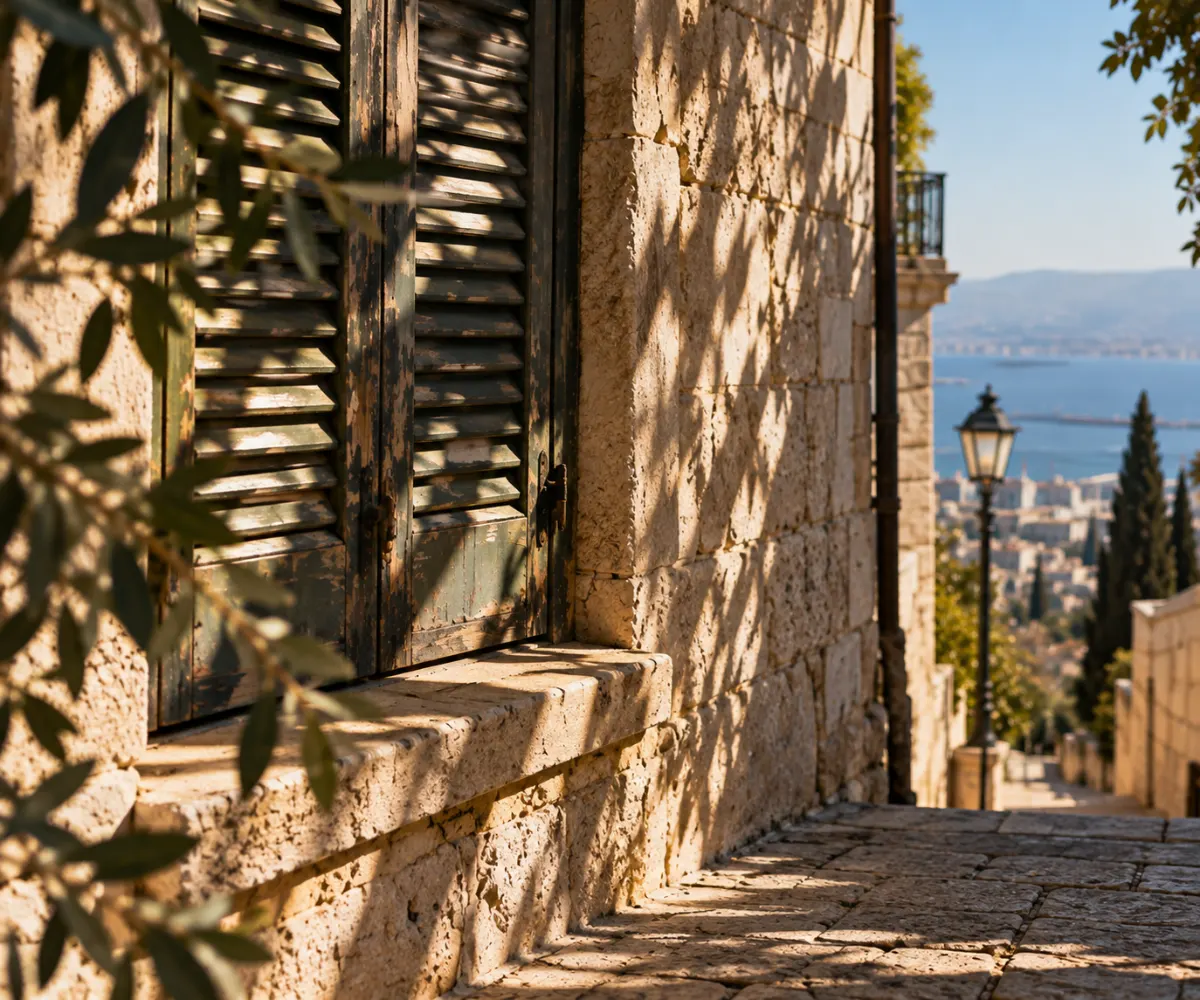
“On a single wall I could touch four different times at once. The street does not remember its history the way we do — it wears it.”
The shadow of people · Reading IV · Inhabitants · Trace · Presence
Those who built the street and lived in it are gone — and their ways of life keep acting in it.
How do people who are no longer here remain present in a place?
Behind every wall stand those who built it, and also those who lived in it: generations of inhabitants from different periods, each bringing a different way of life. The work is not concerned with their identity or their history but with the way their presence remained — in the scale of the houses, in the relation between inside and outside, in the height of a step, and in what is customarily done on the street at given hours. They are physically absent, and their influence is not: it operates in the everyday of whoever passes here now, without that person recognising its source. To walk the street is to live in their shadow.
Here the project leans directly on Christopher Bollas’s “shadow of the object”, the concept that reshaped the research as a whole. Bollas writes about interpersonal relations: he describes how the presence of a formative other continues to shape a person long after they have gone; a shadow difficult to step out of. Bollas himself does not deal with architecture, and the extension of the concept from human relations to architectural experience is the project’s own interpretation: a place, too, carries the shadow of those who made it, and to dwell in it is to live under their influence. The distinction from the previous reading is deliberate and simple: there the evidence is material — what remains in stone and plaster; here the evidence is behavioural — what remains in the way the place works and is inhabited.
In Heidegger’s “Building, Dwelling, Thinking” the claim is grounded. To build is already to make room for dwelling, and the dweller’s relation to the made world is never neutral; the maker’s care remains structurally present in what was built. The street, in this sense, is continually inhabited also by those who built and lived in it before.
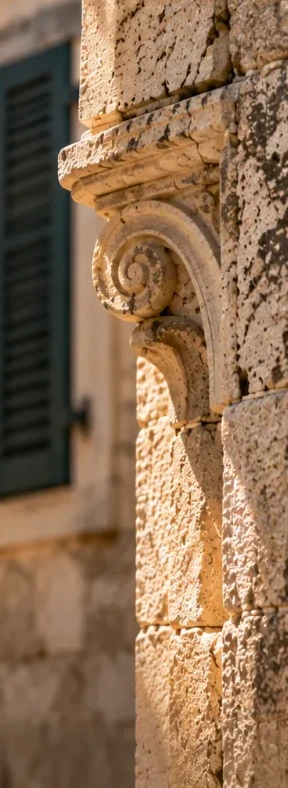
“Someone chose the height of this arch a hundred years ago, and I still walk beneath his decision. That is a shadow you cannot step out of.”
Theoretical framework
Design translation
Phenomenon→Pattern→Material→Body
The readings end in a single translation: the shadow observed on the street becomes a pattern, the pattern becomes a material, and the material returns to the body. This is not a fifth reading but the passage from observation to making — from a phenomenon measured by the eye to a fabric that casts it again.
Here, and not before, the body enters: the pattern read on the wall comes down onto the fabric and is cast again on the person wearing it. The term “second skin” rests on Didier Anzieu and on the idea of an envelope continuous from skin to clothing to space — that is, clothing is treated here as a continuation of the envelope, not as a fashion product.
The translation is made in six documented stages: photographing the shadow on the street · extracting the pattern from the photograph · simplifying it to a line · perforating and cutting the fabric · passing light through the fabric · and the shadow falling back onto the body. A complete garment is not required: one precise, well-made fabric sample holds the argument more firmly than a simulation of a full outfit.
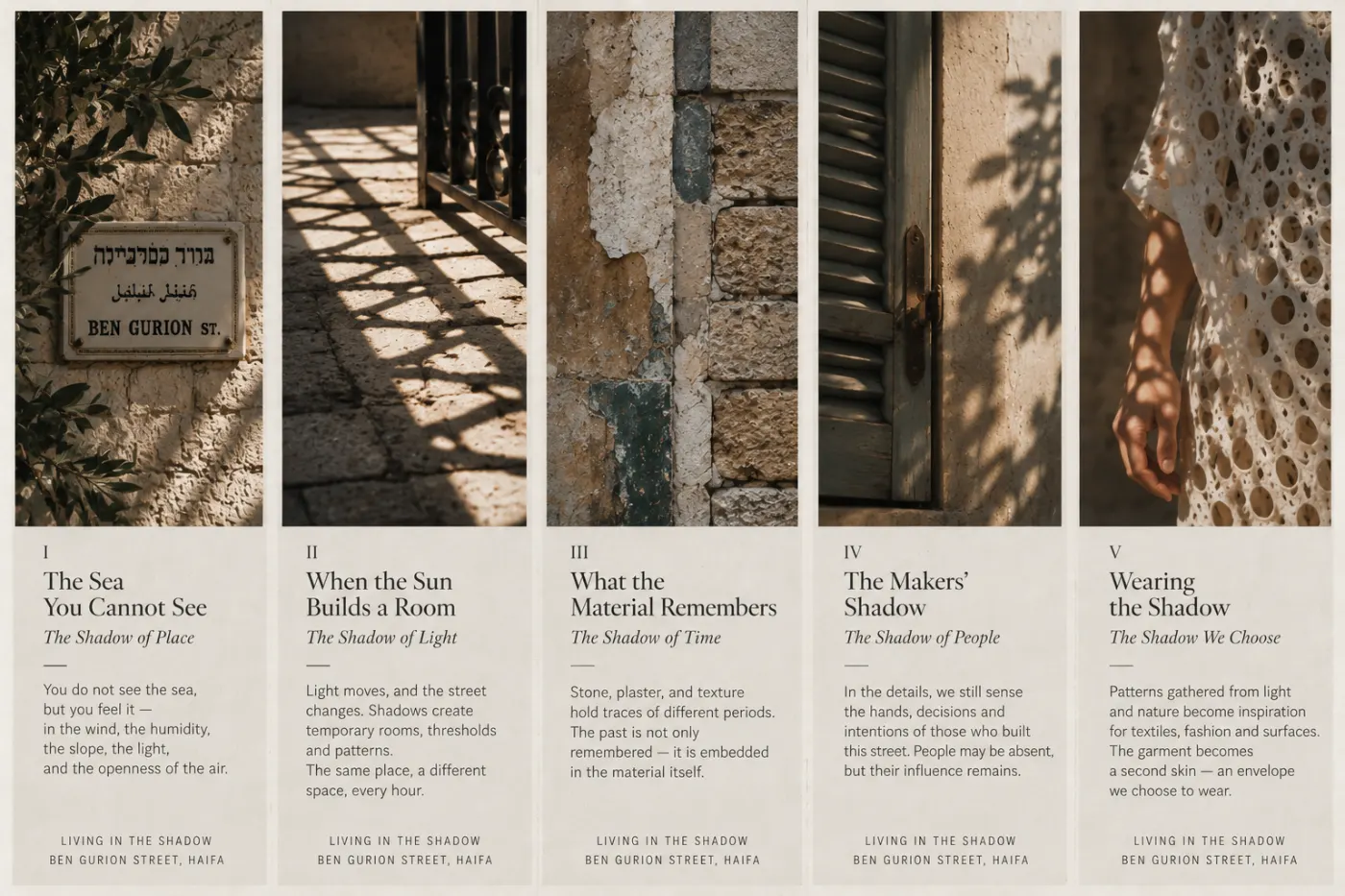
A pattern read across a wall is already raw material for design. The three directions below derive from the readings themselves, and each uses the shadow differently — as pattern, as light control, or as the making of space:
These three directions are not part of the present submission and are noted as a possible continuation of it. The submission itself is limited to a single fabric sample, which shows the full passage from phenomenon to material.
Production list
Each reading rests on a different kind of field evidence. This list defines what will be photographed and produced, and what will replace the visualisations in the document.
All documentation is photographed in the field and by me. In phenomenology the walking, the hour and the body present in the place are part of the evidence — and cannot be delegated to a visualisation.
In closing
A shadow is not only the absence of light. Throughout this work the term has served as a name for whatever acts without being seen: light that builds a room without walls, a landscape beyond the roofline, time that stays in the material, and people who are no longer here while their ways of life remain in the place.
It follows that the visible and the invisible are not two separate worlds. What we see on the street is at every moment the result of what we do not see, and perception moves between the two without our noticing the passage. This is the conclusion the work means to leave: to observe a place is also to acknowledge what acts in it outside the field of vision.